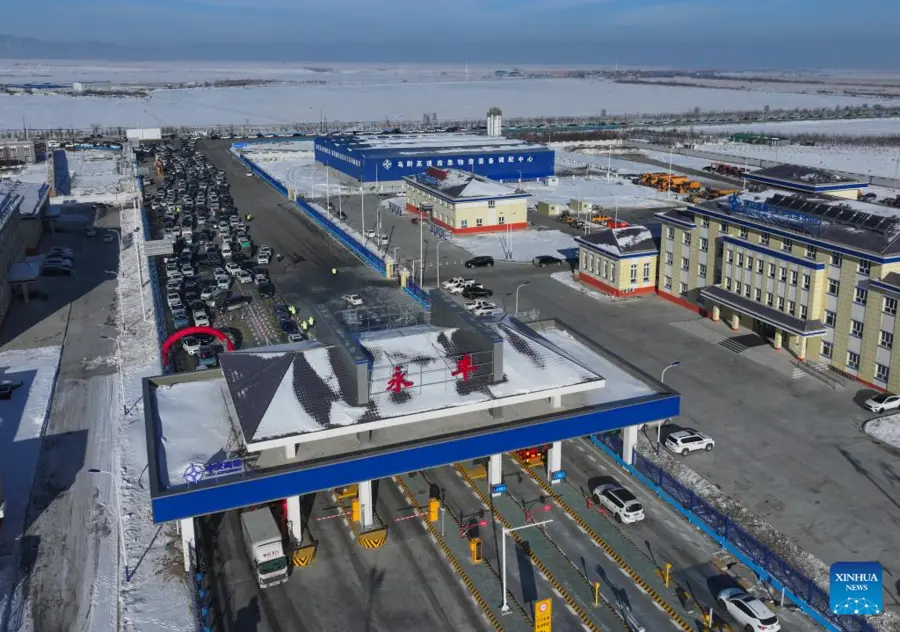
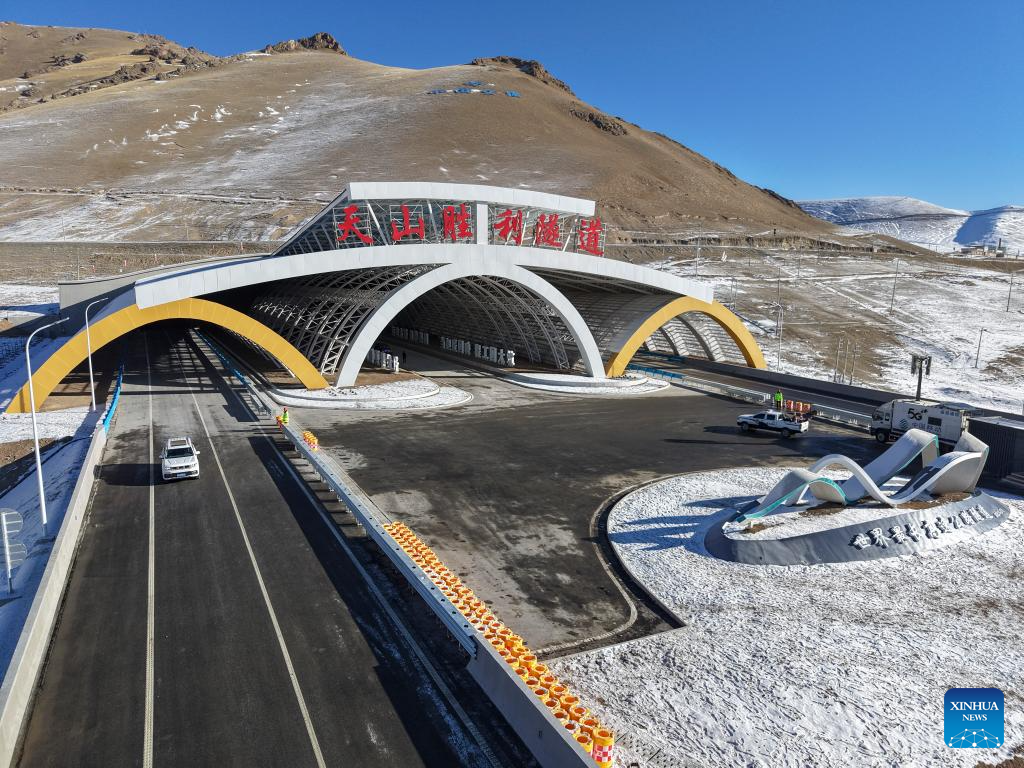
For decades, driving across China’s Xinjiang Uygur Autonomous Region has meant contending with immense distances, high-altitude mountain passes and long winter closures. That reality has shifted dramatically with the opening of the Tianshan Shengli Tunnel, a project that blends record-breaking engineering with regional development ambitions deep beneath the Tian Shan mountains.
Stretching 22.13 kilometres, the Tianshan Shengli Tunnel now stands as the longest operational highway tunnel in the world. It forms the core of the G0711 Urumqi–Yuli Expressway, a vital artery linking northern and southern Xinjiang and cutting what was once a several-hour mountain journey down to just 20 minutes.
The Tian Shan mountain range runs more than 2,500 kilometres across central Xinjiang, historically acting as a formidable natural barrier between the region’s north and south. Urumqi, the regional capital and largest northern city, and Korla, the largest city in the south, were previously separated by a journey of up to seven hours. With the expressway now fully operational, travel time has been reduced to approximately 3 hours, reshaping daily mobility and commercial logistics.
The G0711 expressway does not stop at regional integration. Through connections with existing expressway networks, it links Xinjiang to China’s major economic clusters, including the Beijing–Tianjin–Hebei region, the Yangtze River Delta, the Guangdong–Hong Kong–Macao Greater Bay Area, and the Chengdu–Chongqing economic circle. In doing so, it becomes a strategic hub tying China’s eastern economic heartland more tightly to Eurasian markets.
A Corridor built for scale and resilience
Local officials describe the expressway as an “all-weather, high-efficiency, large-capacity transport corridor”, designed to strengthen the resilience of national energy supplies and agricultural supply chains. For businesses, the impact is already tangible. Transporting raw materials from northern Xinjiang to Yuli County once took three to four days; today, it can be done in one to two days, significantly cutting costs and improving reliability.
Constructed over five years at a cost of 46.7 billion yuan (approximately US$6.63 billion), the 324.7-kilometre expressway represents one of the most complex road projects ever undertaken in western China.
Engineering through hostile mountains
The Tian Shan are not just high; they are geologically unforgiving. Along parts of the route, an 11-kilometre section contains 14 bridges and five tunnels, pushing the bridge-and-tunnel ratio beyond 90 percent. The Tianshan Shengli Tunnel itself posed world-class challenges: a maximum burial depth of 1,112 metres, passage through 16 geological fault zones, and exposure to high ground stress, strong seismic activity, extreme cold and high altitude.
To overcome these obstacles, engineers deployed a mix of construction methods, including conventional drilling and blasting alongside advanced tunnel boring techniques. China’s independently developed pressurized hard-rock tunnel boring machine, used here for the first time on such a scale, helped address long-standing inefficiencies in excavating extremely hard rock.
The tunnel consists of two parallel tubes, each carrying two lanes of traffic, with regular cross-passages for emergency evacuation. A sophisticated ventilation system, dense sensor network and 24-hour control centre monitor air quality, temperature, rock movement and structural stress, turning the tunnel into a continuously observed system rather than a static piece of infrastructure.
Safety, monitoring and long-term operation
Driving through a 22-kilometre tunnel brings unique risks, from driver fatigue to the rapid spread of smoke in the event of an accident. To mitigate these dangers, the tunnel is equipped with automated fire detection, variable lighting, digital signage and loudspeaker guidance. Emergency drills involving traffic police, fire brigades and medical teams are conducted regularly, with scenarios ranging from vehicle fires to seismic events.
Real-time radar and seismic monitoring allow crews to respond quickly to potential rock bursts or structural instability. If sensors detect abnormal conditions, ventilation flows can be reversed, sections closed and traffic redirected within seconds.
Economic integration and tourism potential
Beyond freight and industry, the expressway is expected to transform tourism. The route crosses glaciers, grasslands, forested valleys, Gobi desert and wetlands, offering travelers unprecedented access to the diverse landscapes of the Tian Shan. Long-distance drivers already anticipate a surge in demand, with day trips between northern and southern Xinjiang becoming a realistic option for the first time.
According to regional transport authorities, Xinjiang’s expressway network now exceeds 8,000 kilometres, with expressways and first-class highways together surpassing 13,000 kilometres. As more routes traverse the Tian Shan, two-way flows of goods, people and cultural exchange are expected to accelerate.
Strategic Significance beyond mountains
Xinjiang occupies a pivotal position in China’s westward economic strategy. As a gateway to Central Asia, it plays a central role in the Silk Road Economic Belt, the overland component of the Belt and Road Initiative. Faster, more reliable internal transport strengthens links between oilfields, agricultural basins, industrial zones and rail hubs connecting China to Eurasia.
From a broader perspective, the Tianshan Shengli Tunnel also joins a growing list of Chinese mega-projects designed to demonstrate engineering capability in extreme environments. Alongside offshore bridges, high-speed railways on permafrost and deepwater platforms, it reinforces China’s credentials in delivering complex infrastructure at scale.
The Tianshan Shengli Tunnel is more than a record-setting passage beneath a mountain range. It represents a deliberate effort to reshape geography, turning a historic natural barrier into a predictable, year-round transit corridor. As data from its early years of operation feeds back into global engineering practice, the tunnel will likely influence the design of future mega-projects worldwide.
For now, it stands as a powerful symbol of how infrastructure can compress distance, redefine regional integration and quietly transform everyday life—one 20-minute drive beneath the mountains at a time.
E-mail: [email protected] | Phone/WhatsApp: +254 719 672 296 | Blog website: https://orbital.co.ke/blog/
Ad: Explore the world with Expedia

Flewflew: AI solutions provider in Africa

OrbiCollect: Mobile mapping made easier!

NSE Stock Market: Buy & Sell Shares

Join Binance and Let us win together!

AGM 6th Edition: Jan-Apr 2025